恒星的生命、时代与死亡
我们中有谁路过小报时不会偷偷瞄一眼标题呢?但如果你真的在寻找一个戏剧性的故事,也许该把注意力从好莱坞的明星转向real thing。从诞生到死亡,这些燃烧的气体球体会经历我们宇宙中最极端的一些环境。

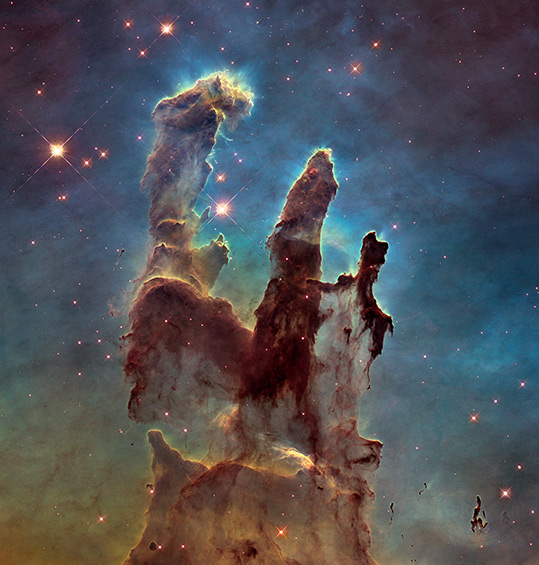
所有恒星都诞生于尘埃和气体云中,就像下图鹰状星云(Eagle Nebula)里的Pillars of Creation一样。在这些stellar nurseries中,气体会聚成团,随着时间推移吸引越来越多的质量。随着它们长大,这些团块开始旋转并升温。一旦它们变得足够重、足够热(比如2700万华氏度或
From then on, stars’ life cycles depend on how much mass they have. Scientists typically divide them into two broad categories: low-mass and high-mass stars. (Technically, there’s an intermediate-mass category, but we’ll stick with these two to keep it straightforward!)
Low-mass stars

A low-mass star has a mass eight times the Sun’s or less and can burn steadily for billions of years. As it reaches the end of its life, its core runs out of hydrogen to convert into helium. Because the energy produced by fusion is the only force fighting gravity’s tendency to pull matter together, the core starts to collapse. But squeezing the core also increases its temperature and pressure, so much so that its helium starts to fuse into carbon, which also releases energy. The core rebounds a little, but the star’s atmosphere expands a lot, eventually turning into a red giant star and destroying any nearby planets. (Don’t worry, though, this is several billion years away for our Sun!)

Red giants become unstable and begin pulsating, periodically inflating and ejecting some of their atmospheres. Eventually, all of the star’s outer layers blow away, creating an expanding cloud of dust and gas misleadingly called a planetary nebula. (There are no planets involved.)
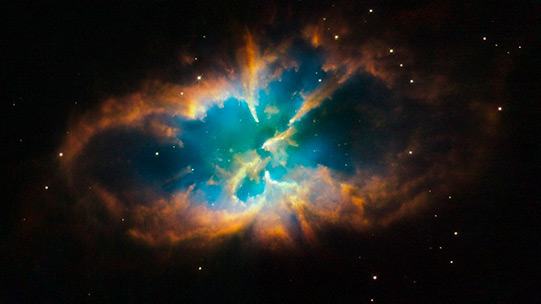
恒星留下的只有它的核心,现在被称为white dwarf,这是一块大约地球大小的恒星余烬,会在数十亿年里逐渐冷却。如果你能舀起一茶匙它的物质,重量会超过一辆皮卡车。

大质量恒星
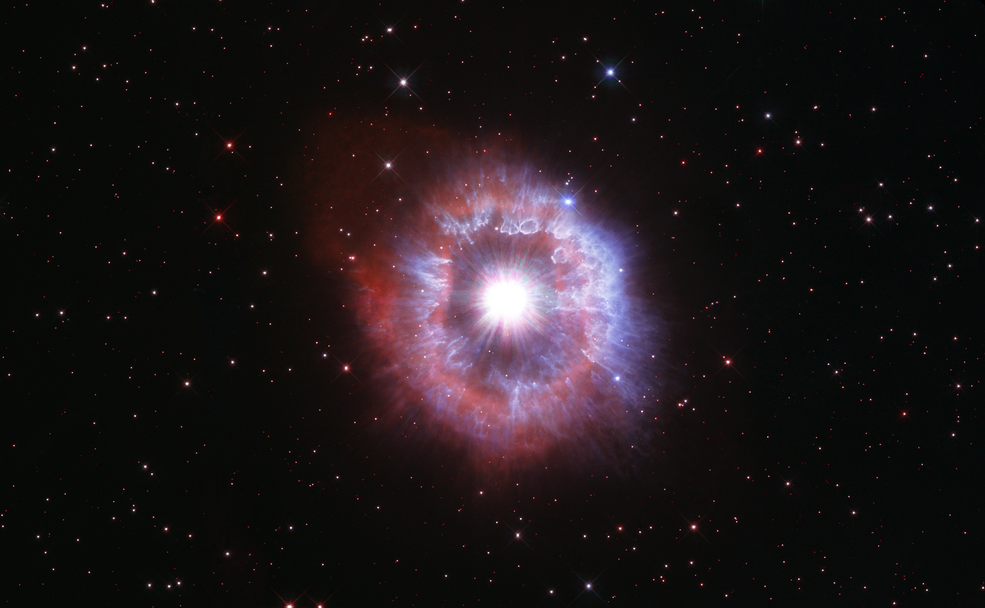
high-mass star的质量是太阳的八倍或更多,可能只存活数百万年。(下图中猎户座的蓝超巨星参宿七,质量是太阳的18倍。)
恒星的铁核会collapses,直到原子核之间的力踩下刹车,然后它又反弹回原来的大小。这一变化产生一道冲击波,穿过恒星的外层。结果就是一场被称为supernova的巨大爆炸。

What’s left behind depends on the star’s initial mass. Remember, a high-mass star is anything with a mass more than eight times the Sun’s — which is a huge range! A star on the lower end of this spectrum leaves behind a city-size, superdense neutron star. (Some of these weird objects can spin faster than blender blades and have powerful magnetic fields. A teaspoon of their material would weigh as much as a mountain.)

At even higher masses, the star’s core turns into a black hole, one of the most bizarre cosmic objects out there. Black holes have such strong gravity that light can’t escape them. If you tried to get a teaspoon of material to weigh, you wouldn’t get it back once it crossed the event horizon — unless it could travel faster than the speed of light, and we don’t know of anything that can! (We’re a long way from visiting a black hole, but if you ever find yourself near one, there are some important safety considerations you should keep in mind.)

The explosion also leaves behind a cloud of debris called a supernova remnant. These and planetary nebulae from low-mass stars are the sources of many of the elements we find on Earth. Their dust and gas will one day become a part of other stars, starting the whole process over again.
That’s a very brief summary of the lives, times, and deaths of stars. (Remember, there’s that whole intermediate-mass category we glossed over!)