中子星很奇特!

镜像快照 · 2026-11-05 · 查看 NASA 原文 ↗

瞧,我们就这么直说了。它们也没办法;当一颗恒星比我们的太阳更重,却只有一座城市那么大时,就会变成这样。中子星让我们得以接触地球上无法直接研究的极端条件。

以下是关于中子星的五个事实,它们表明中子星有时比科幻小说还要离奇!

1. 中子星以一声巨响开始生命

This visualization opens on a star field with a bright star at the center of the image. The star then explodes, filling the frame with white light for a moment. As that bright light fades, we see there is a bubble of yellow and red material expanding away from the site of the exploded star.
当一颗比太阳大八倍的恒星走到生命尽头时,它并不会温柔地步入那良夜。核心压力的变化使它坍缩,并引发超新星(supernova)爆发——宇宙中最大的爆炸之一。最初的那道闪光可能只持续几秒钟,却能比这颗恒星所在的星系还要明亮。但它抛射到太空中的碎片,却可以被研究数千年。图片来源:ESA/哈勃/L. Calçada

当一颗比我们的太阳更大、质量更高的恒星在生命末期耗尽燃料时,它的核心会坍缩,外层则在超新星爆发中被吹散。留下什么取决于原来恒星的质量。如果它大约是太阳质量的

2. Neutron stars contain the densest material that we can directly observe

An imagined neutron star hangs over San Francisco. The blue and black ball spins just above the clouds.
This animation shows the size and scale of a neutron star over San Francisco. Neutron stars squeeze up to two solar masses into a city-size volume, giving rise to the highest stable densities known anywhere. The nature of matter under these conditions is a decades-old unsolved problem.
NASA’s Goddard Space Flight Center/Conceptual Image Lab

While neutron stars’ dark cousins, black holes, might get all the attention, neutron stars are actually the densest material that we can directly observe. Black holes are hidden by their event horizon, so we can’t see what’s going on inside. However, neutron stars don’t have such shielding. To get an idea of how dense they are, one sugar cube of neutron star material would weigh about 1 trillion kilograms (or 1 billion tons) on Earth – about as much as a mountain. That is what happens when you cram a star with up to twice the mass of our Sun into a sphere the diameter of a city.

3. Neutron stars can spin as fast as blender blades
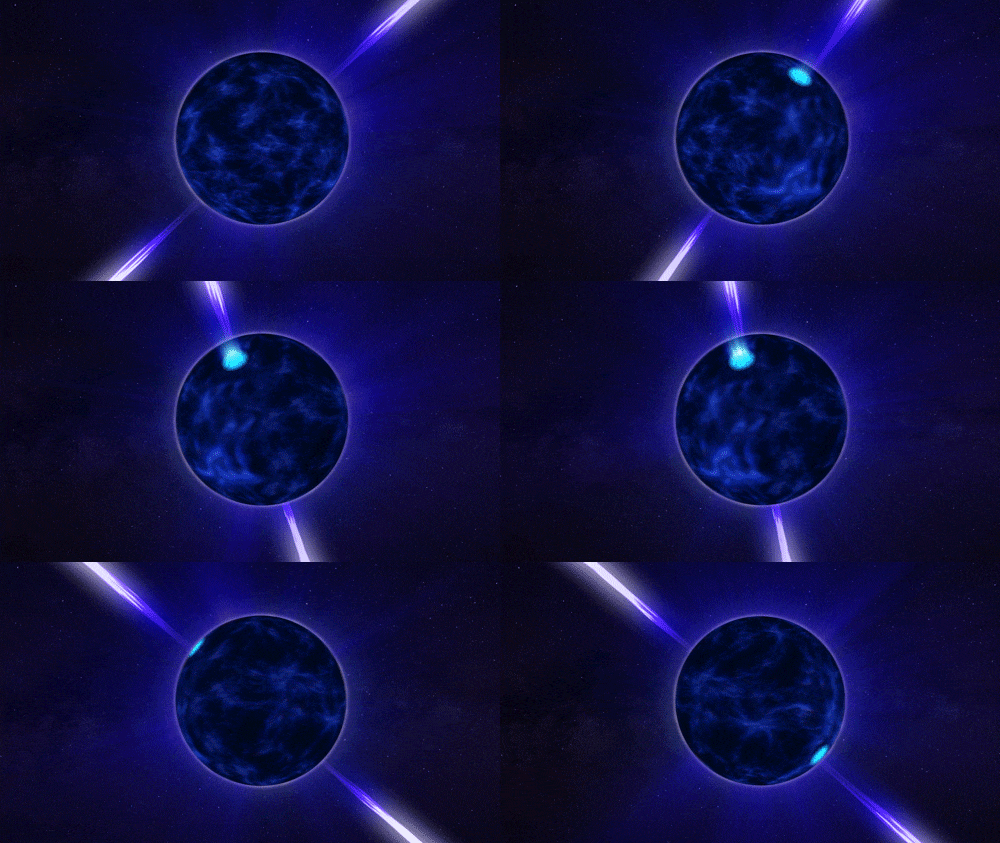
A mottled blue and black ball, representing a neutron star, spins about once per second. There are light blue ovals on opposite sides of the neutron star representing hotspots on its surface that are offset from the spin axis. From each oval is a beam of light extending from the oval out of the frame. As the star spins, the hotspots and beams come in and out of our view, making it look like the star is pulsing.
Animation of a spinning neutron star in space. Neutron stars are directly observable, usually as “pulsars” – the lighthouses of the cosmos.
NASA’s Goddard Space Flight Center/Conceptual Image Lab

Some neutron stars, called pulsars, emit streams of light that we see as flashes because the beams of light sweep in and out of our vision as the star rotates. The fastest known pulsar, named PSR J1748-2446ad, spins 43,000 times every minute. That’s twice as fast as the typical household blender! Over weeks, months or longer, pulsars pulse with more accuracy than an atomic clock, which excites astronomers about the possible applications of measuring the timing of these pulses.

4. 中子星是已知最强的磁体

A yellow ball spins at the center of the image, representing a neutron star. The magnetic field lines are visualized as electric blue lines that spin with the star. The lines start near the top of the sphere, arc out into space, landing back on the bottom of the sphere. The field lines closest to the top of the neutron star spill off the screen.
这段动画带我们进入一颗旋转的脉冲星,它强大的磁场也随之旋转。带电粒子云沿着磁力线运动,它们的伽马射线被磁场像灯塔光束一样定向射出。当我们的视线进入光束时,每当中子星旋转一圈,我们就能看到一次脉冲。NASA戈达德太空飞行中心/概念图像实验室

和太空中许多天体(包括地球)一样,中子星也有磁场。所有已知中子星的磁场都比地球强数十亿到数万亿倍,而一种被称为磁星的中子星,其磁场还能再强一千倍。这些极强的磁力会在磁星表面引发星震,撕裂星壳,并产生极其明亮的伽马射线闪光,已知这些闪光能穿越我们银河系数千光年,对地球高层大气造成可测量的变化。

5. 中子星的脉冲最初被认为可能是外星信号

A star shown in purple at the center of this starfield pulses, quickly getting brighter and dimmer.
脉冲星是一颗中子星,它发出的辐射束会扫过地球的视线方向。我们在这段动画中看到的脉冲星高能辐射“脉冲”,源于中子星自转轴与磁轴的不对齐。只要磁极上方的这一区域可见,外部观察者就能看到辐射脉冲。NASA戈达德太空飞行中心

嘀。嘀。嘀。脉冲星的发现始于1967年的一个谜团,当时天文学家接收到非常规律的射电闪光,却无法弄清是什么造成的。早期研究人员曾短暂考虑过这可能是外星文明信号的想法,这一解释后来被抛弃,但却留在了他们对最初天体的昵称中——LGM-1,暗指“小绿人”(后来它被重新命名为PSR B1919+21)。当然,现在科学家已经明白,脉冲星是旋转的中子星,发出覆盖很宽波长范围的光,我们将其探测为非常规律的脉冲——但最初的探测确实让观察者们一时摸不着头脑。
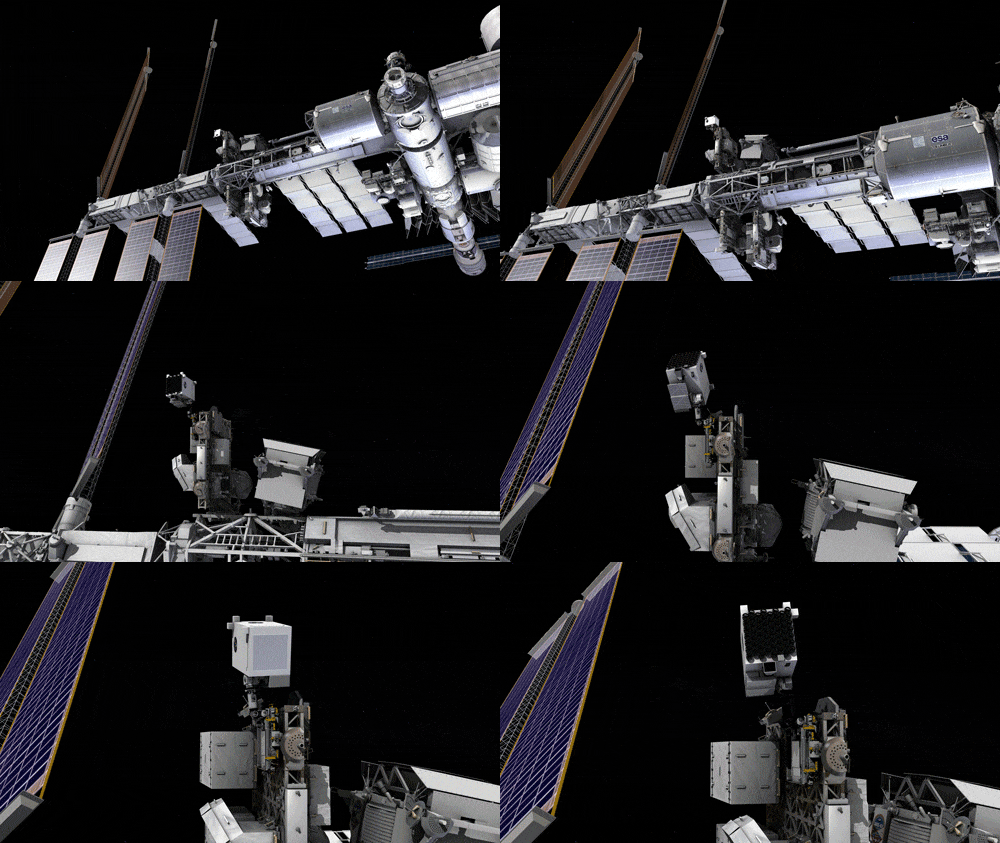
This animation starts on a wide shot of the International Space Station and zooms in to the location where the NICER payload is found. NICER is a box-shaped instrument that connects to the space station with a single arm, and it swivels in this animation, showing how it can point to different objects in the sky.
这段动画展示了国际空间站上NICER载荷的广角视图和放大画面。NASA戈达德太空飞行中心/概念图像实验室

我们在国际空间站上的Neutron star Interior Composition Explorer (NICER)载荷正在为天文学家提供更多关于中子星的见解——helping us determine what is under the surface。

想了解更多关于中子星的知识吗?观看这个……

This video explains some of what’s known about neutron stars and previews NASA’s Neutron star Interior Composition Explorer mission (NICER).
NASA’s Goddard Space Flight Center
Keep Exploring

Discover More Topics From NASA

内容镜像自 NASA(public domain),中文译文由 AI 辅助生成、仅供参考。