解码星云

镜像快照 · 2026-11-05 · 查看 NASA 原文 ↗

We can agree that nebulae are some of the most majestic-looking objects in the universe. But what are they exactly? Nebulae are giant clouds of gas and dust in space. They’re commonly associated with two parts of the life cycle of stars: First, they can be nurseries forming new baby stars. Second, expanding clouds of gas and dust can mark where stars have died.

A rotating gif of examples of a stellar nursery, NGC 346, and a planetary nebula, the Helix Nebula. The stellar nursery is a blue wispy cloud taking up nearly the entire scene and bright stars can be see dotted throughout the image, with bright ones near the center of the cloud. The Helix nebula looks like a giant eye with a blue center and pale yellow light fading into orange to form the “white” of the eye. redit: Helix Nebula image: NASA, NOAO, ESA, the Hubble Helix Nebula Team, M. Meixner (STScI), and T.A. Rector (NRAO); NGC 346: NASA, ESA and A. Nota (STScI/ESA)
这张GIF在两幅图像之间轮换:一幅是名为螺旋星云(Helix Nebula)的行星状星云,另一幅是名为NGC 346的恒星孕育场。螺旋星云展示了一张由丝状“自行车辐条”结构组成的精细网络,镶嵌在红蓝相间的彩色气体环中。这类星云是一颗正在死亡的类太阳恒星周围发光的气体。NGC 346中有一群婴儿恒星,它们仍在由引力坍缩的气体云中形成。它们还没有点燃自己的氢燃料来维持核聚变。这些婴儿恒星中最小的质量只有我们太阳的一半。

并非所有星云都一模一样,它们不同的外观告诉我们周围正在发生什么。

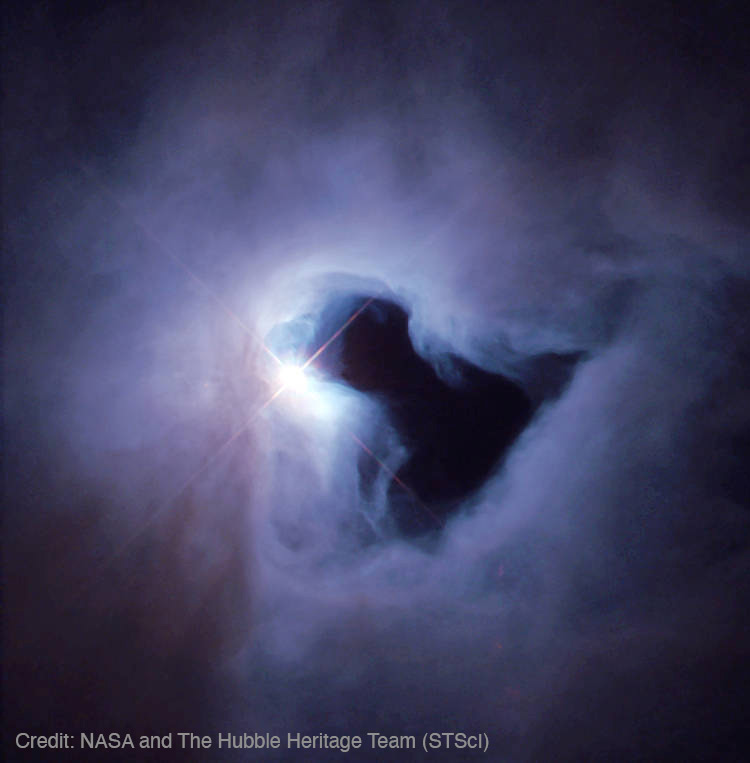
A gray haze fills most of the frame with a large black region in the shape of a game pawn tilted about 45-degrees to the left. Credit: NASA and The Hubble Heritage Team (STScI)
A dusty bright nebula contrasts dramatically with a dusty dark nebula in this Hubble Space Telescope image. The nebula, cataloged as NGC 1999, is a reflection nebula, which shines by reflecting light from a nearby star. Unlike emission nebulae, whose reddish glow comes from excited atoms of gas, reflection nebulae have a bluish cast as their interstellar dust grains preferentially reflect blue starlight.
NASA and The Hubble Heritage Team (STScI)

In another type, called emission nebulae, stars heat up the clouds of gas, whose chemicals respond by glowing in different colors. Think of it like a neon sign hanging in a shop window!
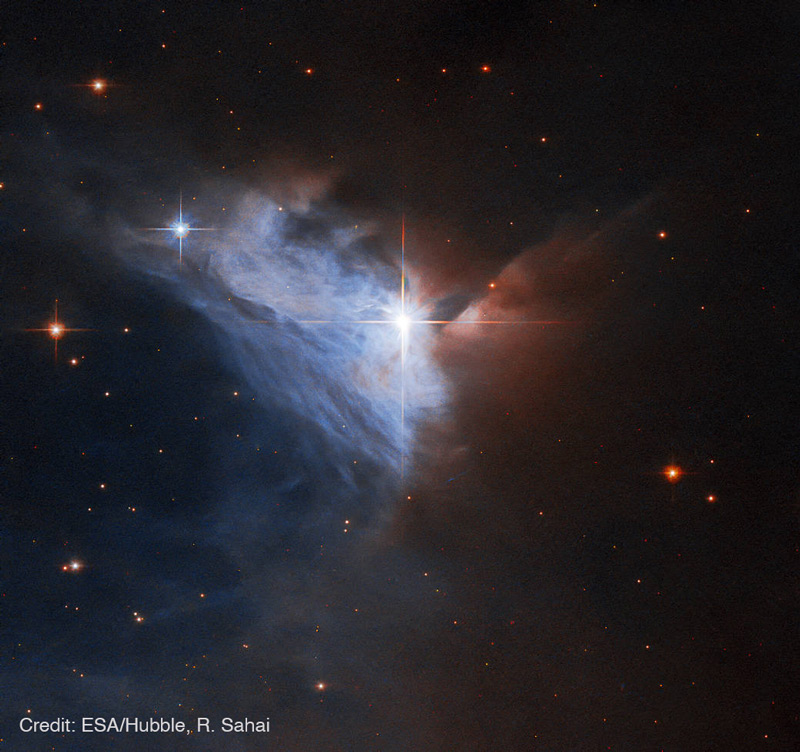
Near the center of the image shines a bright star with four spikes. It forms a vertex of a triangle of wispy blue and blue-white light that forms the emission nebula taking up about a third of the image. To the right and above the bright star, the image quickly fades from pale red to black, which is where a dense cloud of dust blocks our view of the nebula. Credit: ESA/Hubble, R. Sahai
Emission nebulae are bright, diffuse clouds of ionized gas that emit their own light. In NGC 2313, pictured here, the bright star V565 (center of the image) highlights a silvery veil of gas and dust, while the right half of this image is obscured by a dense cloud of dust.
ESA/Hubble, R. Sahai

Finally there are nebulae with dust so thick that we’re unable to see the visible light from young stars shine through it. These are called dark nebulae.
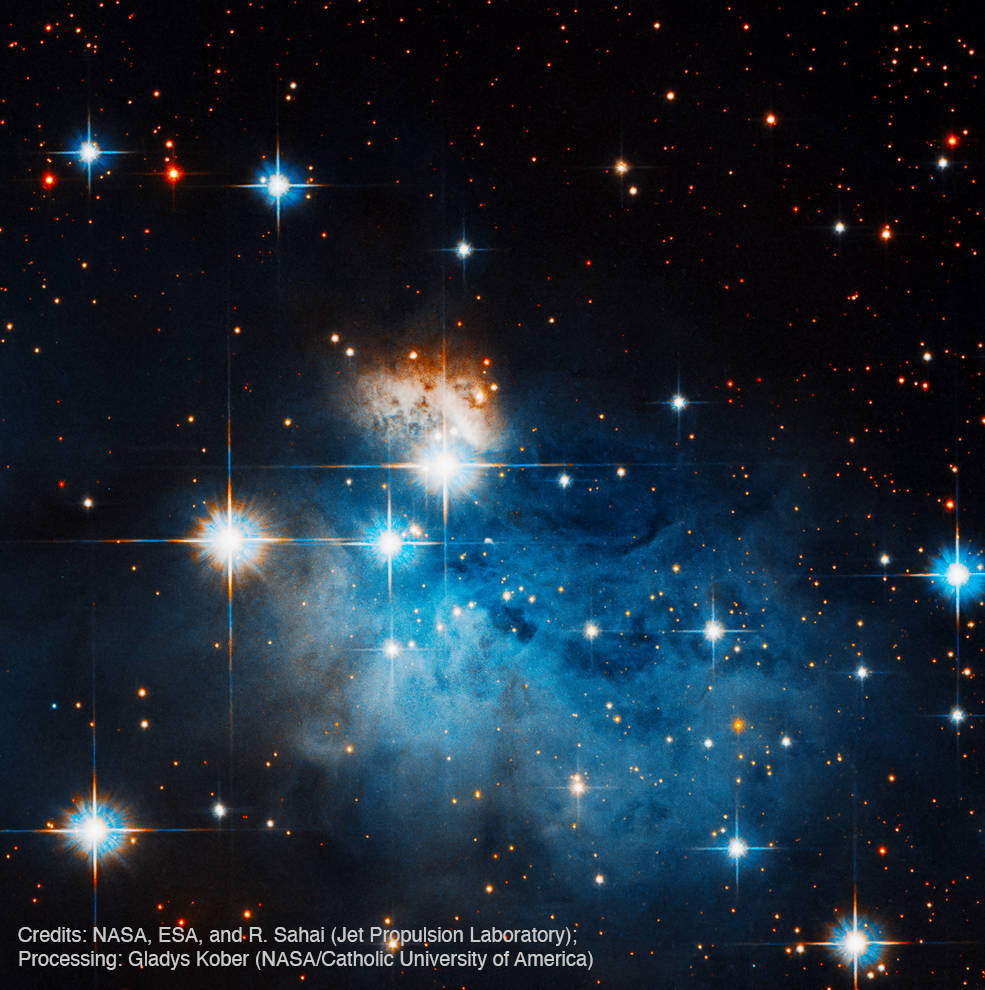
Against a starry background, this nebula looks like a flowing dress with a reddish-white bodice and flowing faint blue skirt. In the foreground are a few bright stars, each having four rainbow spikes. Credit: NASA, ESA, and R. Sahai (Jet Propulsion Laboratory); Processing: Gladys Kober (NASA/Catholic University of America)
Caldwell 99 is a dark nebula — a dense cloud of interstellar dust that completely blocks out visible wavelengths of light from objects behind it. The object at the center of the image is a (much smaller) protoplanetary nebula, which represents a late stage in the life of a star that has ejected a shell of hydrogen gas and is quickly heating up.
NASA, ESA, and R. Sahai. (Processing: Gladys Kober)

Our missions help us see nebulae and identify the different elements that oftentimes light them up.

The Hubble Space Telescope is able to observe the cosmos in multiple wavelengths of light, ranging from ultraviolet, visible, and near-infrared. Hubble peered at the iconic Eagle Nebula in visible and infrared light, revealing these grand spires of dust and countless stars within and around them.

This pair of images of the Eagle Nebula in visible and near-infrared light were taken by the Hubble Space Telescope. In optical light a dark cloud with three “fingers” poking across the image from the left on a background awash in blue and orange cloudy light. The edges of the dark regions glow with white and light-blue light. In infrared light the orange and blue clouds fade into a dark background, revealing a densely populated star field. Between the fingers and at their tips, there is still a glow of faint blue light. Credit: NASA, ESA and the Hubble Heritage Team (STScI/AURA)
这些宇宙尘埃和气体的触须位于M16(鹰星云)的中心。这些恰如其名的“创生之柱”出现在这些令人惊叹的哈勃图像中,是星云内一个活跃的恒星形成区的一部分,在其纤细的柱状结构中隐藏着新生恒星。在光学图像中,蓝色代表氧,红色代表硫,绿色同时表示氮和氢。第二张较暗的图像显示了哈勃的红外视图,穿透了M16创生之柱中遮蔽视线的气体和尘埃。NASA、ESA 和 G. Bacon(STScI)

Chandra X-ray Observatory用X射线研究宇宙!该航天器正在帮助科学家看到星云内部的某些特征,而这些特征在可见光和红外线等较长波段下观测时可能会被气体和尘埃遮挡。在Crab Nebula中,钱德拉看到了来自a pulsar的高能X射线(这是一种快速自转的中子星,是一颗以超新星方式爆炸的恒星被压碎后形成的城市大小核心)。
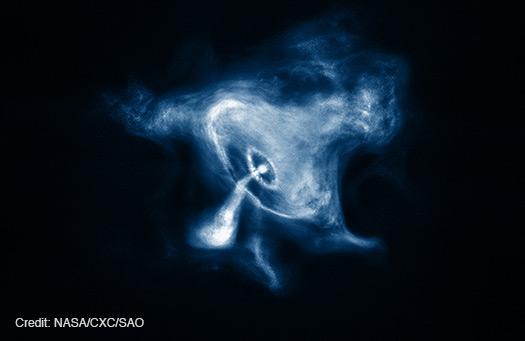
The X-ray emission from the Crab nebula is shown in shades of blue. At the center is a bright ball surrounded by an oval of light whose long axis is tilted just to the left. Rising up and to the right from that oval is a cloud of material that looks like a witch’s hat with a broad brim and dented point. From the central ball there is also a bent stream of material to the left and downward. Credit: NASA/CXC/SAO
这张由钱德拉X射线天文台拍摄的蟹状星云,由一个快速自转、高度磁化的中子星——脉冲星提供能量,它是在一颗大质量恒星耗尽核燃料并坍缩时形成的。NASA/CXC/SAO

James Webb Space Telescope主要观测红外宇宙。借助韦布,科学家们正在深入尘埃和气体云内部,研究恒星和行星系统是如何形成的。
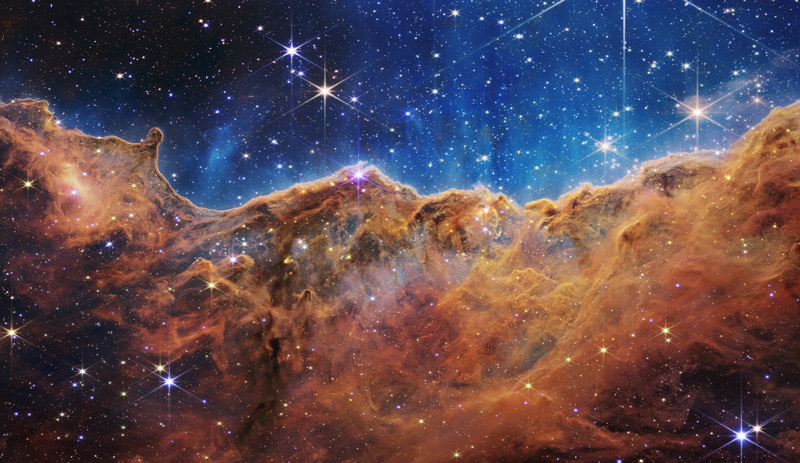
An undulating, translucent star-forming region in the Carina Nebula is shown in this Webb image, hued in ambers and blues; foreground stars with diffraction spikes can be seen, as can a speckling of background points of light through the cloudy nebula. Credit: NASA's Goddard Space Flight Center
这看似三维的“宇宙悬崖”展示了詹姆斯·韦伯太空望远镜穿透遮蔽尘埃的能力,并为恒星如何形成带来了新的认识。韦布揭示了在可见光照片中完全被隐藏的新生恒星孕育区和一颗颗恒星。这片“山脉”和“山谷”的景观实际上是船底座星云西北角一个名为NGC 3324的邻近恒星孕育区的边缘。NASA、ESA、CSA 和 STScI

Spitzer Space Telescope在2020年退役前对宇宙进行了超过16年的研究。在其探测器的帮助下,斯皮策揭示了隐藏在星云中的未知物质——比如形状奇特的分子和类似烟灰的物质,这些都是在California Nebula中发现的。
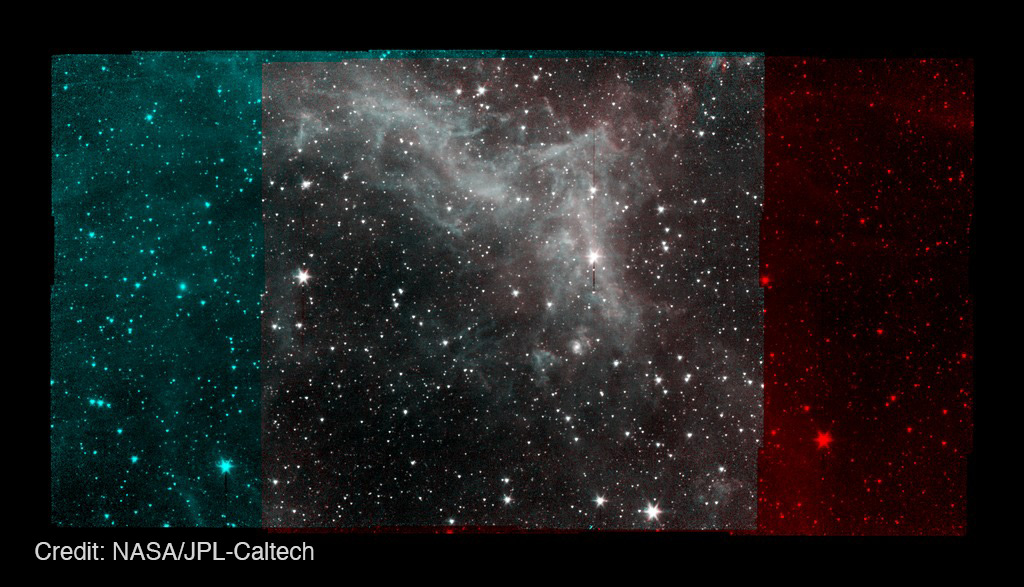
This image shows two overlapping, but offset, images of the California Nebula. A central square where they overlap shows a black stary background with a cloudy gray nebula swoosh taking up about a third of the image. The image continues to the left of the square in blue hues, representing the image from one of the Spitzer detectors. The other image continues to the right in red hues, from another detector. Credit: NASA/JPL-Caltech
这一系列红外图像由NASA的斯皮策太空望远镜于2020年1月25日拍摄,展示了加利福尼亚星云的一部分,该星云距离地球约1,000光年。

Studying nebulae helps scientists understand the life cycle of stars. Did you know our Sun got its start in a stellar nursery? Over 4.5 billion years ago, some gas and dust in a nebula clumped together due to gravity, and a baby Sun was born. The process to form a baby star itself can take a million years or more!

This visualization provides a three-dimensional perspective on Hubble's image of the nebula Gum 29 with the star cluster Westerlund 2 at its core. The flight traverses the foreground stars and approaches the lower left rim of the nebula Gum 29. Passing through the wispy darker clouds on the near side, the journey reveals bright gas illuminated by the intense radiation of the newly formed stars of cluster Westerlund 2. Within the nebula, several pillars of dark, dense gas are being shaped by the energetic light and strong stellar winds from the brilliant cluster of thousands of stars. Credit: NASA, ESA, G. Bacon, L. Frattare, Z. Levay, and F. Summers (Viz3D Team, STScI), and J. Anderson (STScI)
A visualization flying into the nebula Gum 29 and the star cluster Westerlund 2 at its core.
NASA, ESA, Greg Bacon, Lisa Frattare, Zolt Levay, and Frank Summers (Viz3D Team, STScI), and Jay Anderson (STScI) (Acknowledgment: The Hubble Heritage Team (STScI/AURA), A. Nota (ESA/STScI), the Westerlund 2 Science Team, and ESO)

After billions more years, our Sun will eventually puff into a huge red giant star before leaving behind a beautiful planetary nebula (so-called because astronomers looking through early telescopes thought they resembled planets), along with a small, dense object called a white dwarf that will cool down very slowly. In fact, we don’t think the universe is old enough yet for any white dwarfs to have cooled down completely.

Since the Sun will live so much longer than us, scientists can’t observe its whole life cycle directly … but they can study tons of other stars and nebulae at different phases of their lives and draw conclusions about where our Sun came from and where it’s headed. While studying nebulae, we’re seeing the past, present, and future of our Sun and trillions of others like it in the cosmos.

A circular view of the sky captured by NASA’s TESS mission unfolds like a paper fan around a central point in this animated GIF. Each segment looks like a film strip studded with stars. Credit: NASA/MIT/TESS and Ethan Kruse (USRA)
美国国家航空航天局(NASA)的凌星系外行星巡天卫星(TESS)花了一年时间,拍摄了布满各种恒星的南天天空,同时搜寻太阳系之外的世界。NASA/MIT/TESS 与 Ethan Kruse(USRA)
Keep Exploring

探索更多 NASA 主题

内容镜像自 NASA(public domain),中文译文由 AI 辅助生成、仅供参考。