暗物质入门:寻找缺失的质量

镜像快照 · 2026-11-05 · 查看 NASA 原文 ↗

事情是这样的——在 NASA,我们会分享各种各样的精彩图片,比如 planets、stars、galaxies、astronauts、other humans 等等,但这些照片只能捕捉到宇宙中的一部分。每一张图片都只显示普通物质(科学家有时称之为重子物质),也就是由质子、中子和电子构成的物质。天文学家面临的难题是:宇宙中大部分物质并不是普通物质——而是一种神秘的 substance called dark matter。
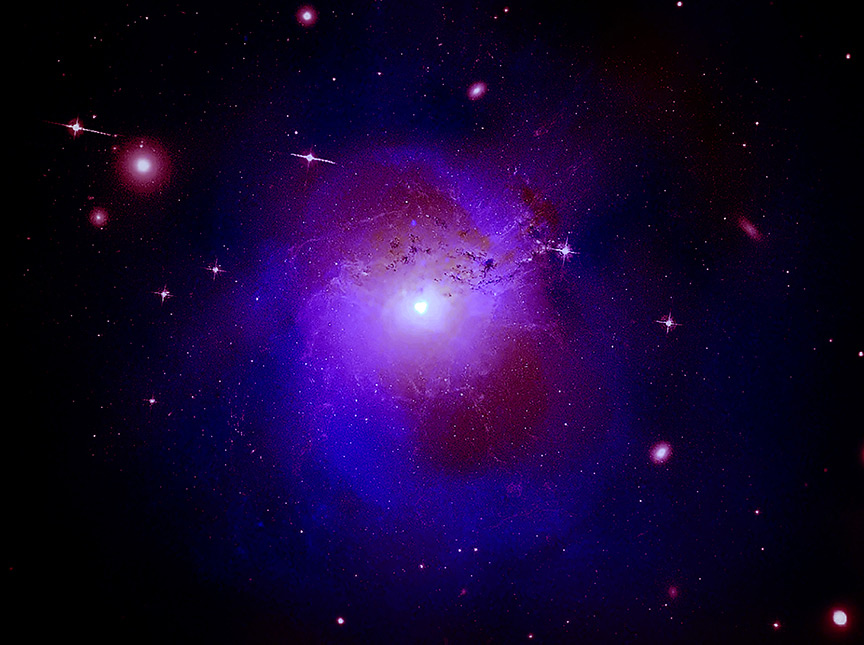
A bright white spot at the center of the image is surrounded by a blue and red halo. The blue represents X-ray emission and appears as a thick “0” around the bright center. The red halo is optical and radio light, which fills the middle of the X-ray emission. Dotted around the image are additional white spots, which are galaxies and foreground stars.
这张图片展示了钱德拉望远镜拍摄的英仙座星系团 X 射线数据(蓝色),以及哈勃望远镜的光学数据(粉色)和甚大阵的射电辐射数据(红色)。X 射线:NASA/CXO/Fabian 等;射电:Gendron-Marsolais 等,NRAO/AUI/NSF;光学:NASA、SDSS

What is dark matter?我们其实

Misbehaving galaxies

The first hint that we might be missing something came in the 1930s when astronomers noticed that the visible matter in some clusters of galaxies wasn’t enough to hold the cluster together. The galaxies were moving so fast that they should have gone zinging out of the cluster before too long (astronomically speaking), leaving no cluster behind.

Two purple spiral galaxies rotate side by side. All the stars in the left-hand galaxy rotate at the same angular rate, like an old-fashioned vinyl record on a turntable. The stars in the right-hand galaxy rotate at different rates, depending on how far out from the center they are, with the fastest rotation toward the center. The result is a little like twirling pasta around a fork, where there’s a build-up of pasta/stars at the center.
This simulation shows two spiral galaxies with material orbiting based on two different mass models. The one on the left shows a galaxy where all of the visible stars rotate at the same angular rate, like an old-fashioned vinyl record on a turntable. The visible material in the galaxy on the right has different rotation rates, depending on how far out from the center they are, with the fastest rotation toward the center. We expected galaxies to exhibit rotation like one on the right, given mass estimates based on the luminous matter alone. However, observations have shown that galaxies rotate more like the galaxy on the left, pointing to a huge amount of matter that is unseen at any wavelength of light that we can detect.
ESO/L. Calçada

It turns out, there’s a similar problem with individual galaxies. In the 1960s and 70s, astronomers mapped out how fast the stars in a galaxy were moving relative to its center. The outer parts of every single spiral galaxy the scientists looked at were traveling so fast that they should have been flying apart.
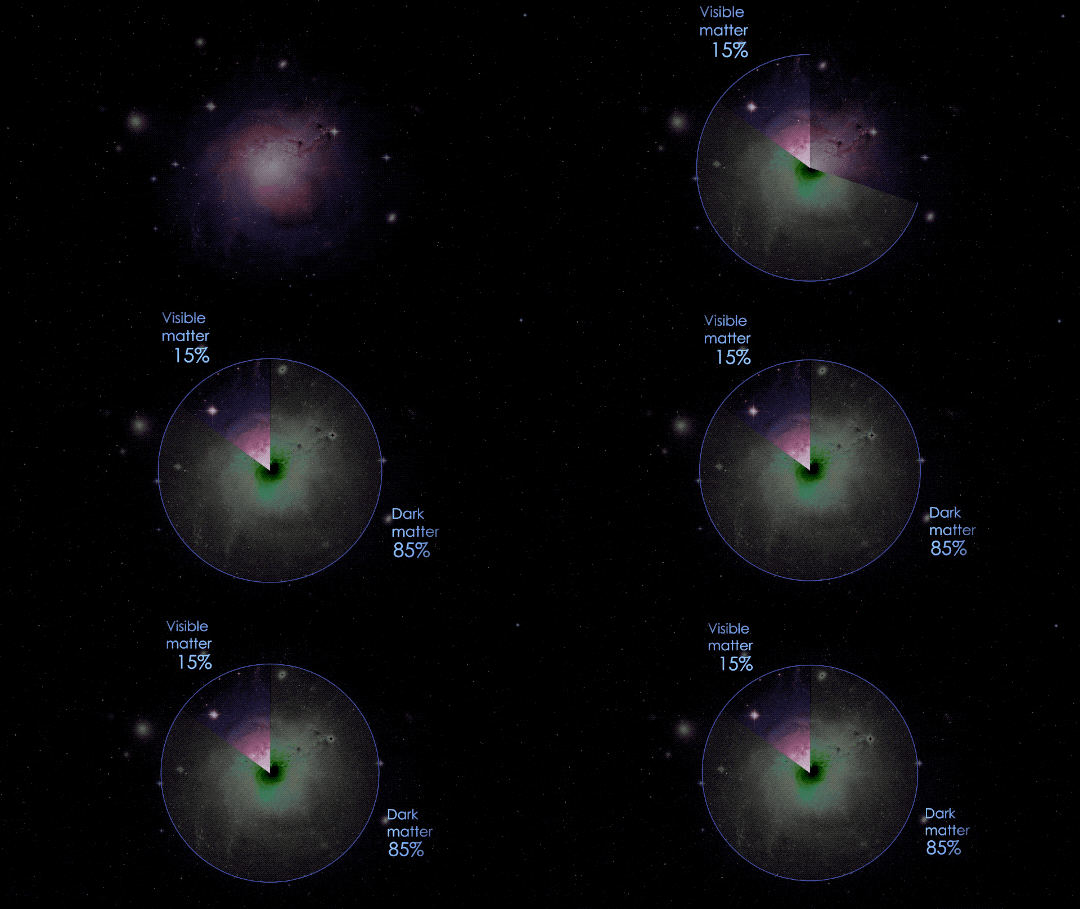
Against the backdrop of a galaxy, a circular chart is drawn out showing one segment that’s 15% of the circle, which represents visible matter, and the rest, at 85%, representing dark matter.
This animated pie chart shows rounded values for the two known matter components of the universe: visible (15%) and dark (85%).
NASA

Something was missing – a lot of it! In order to explain how galaxies moved in clusters and stars moved in individual galaxies, they needed more matter than scientists could see. And not just a little more matter. A lot … a lot, a lot. Astronomers call this missing mass “dark matter” — “dark” because we don’t know what it is. There would need to be five times as much dark matter as ordinary matter to solve the problem.

把万物聚在一起

暗物质让星系和星系团不至于四分五裂,这意味着暗物质会经历gravity the same way we do。
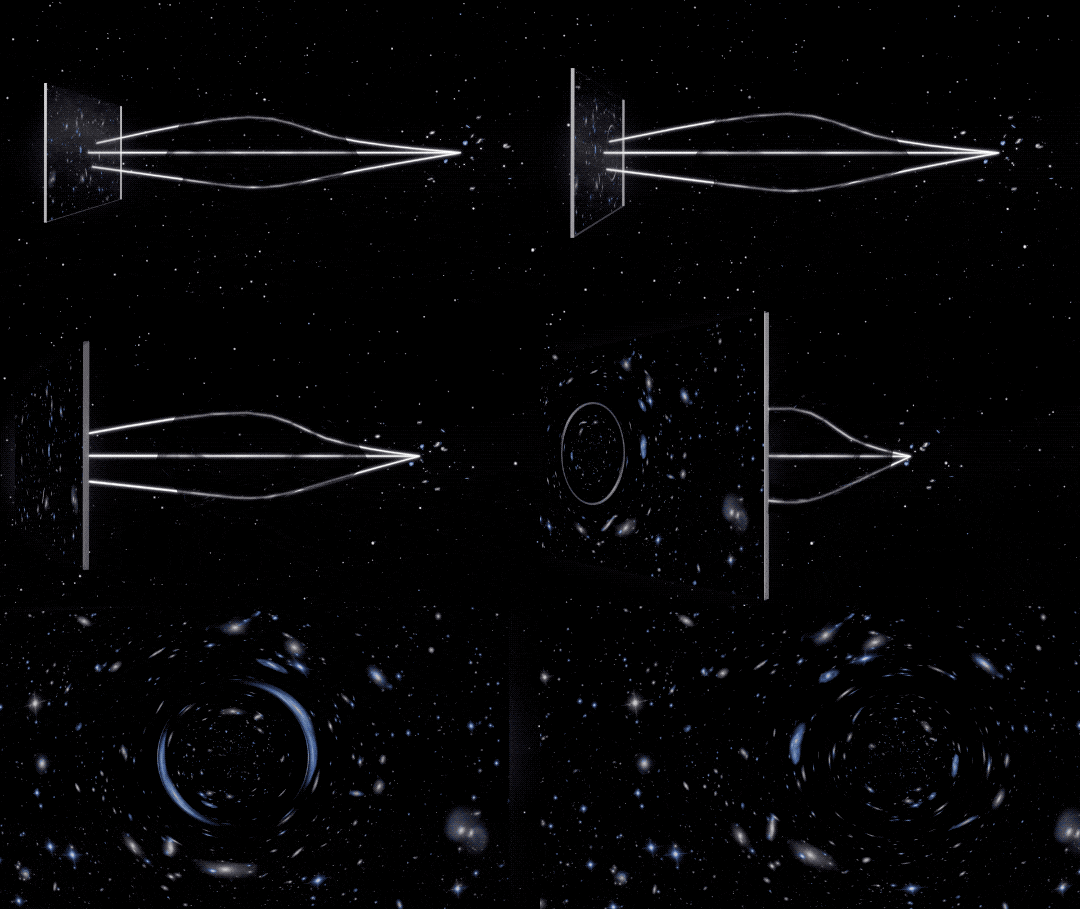
This animation shows light rays from a distant cluster of galaxies, on the right, as they are deflected above, below and around a source of dark matter, then continue on their way to the viewer. The viewer’s perspective is shown as flat image at the end of the light path, which turns toward the viewer showing the image of galaxies that are skewed in arcs around a central point.
动画展示了来自一个星系团的光被暗物质透镜化的过程。NASA戈达德太空飞行中心/概念图像实验室

除了把万物聚在一起,暗物质还像其他任何有质量的物质一样会扭曲时空。有时我们会在光传向我们的途中看到distant galaxies whose light has been bent around massive objects。这会让星系看起来被拉长或扭曲。These distortions provide another measurement of dark matter。

尚未发现的粒子?

过去几十年来,关于暗物质可能是什么,出现过许多理论;例如,暗物质会不会是黑洞和中子星——那些不再发光的死亡恒星?然而,大多数理论都已被否定。目前,一类领先的候选者涉及一种尚未被发现的基本粒子,叫做WIMPs,即弱相互作用大质量粒子。
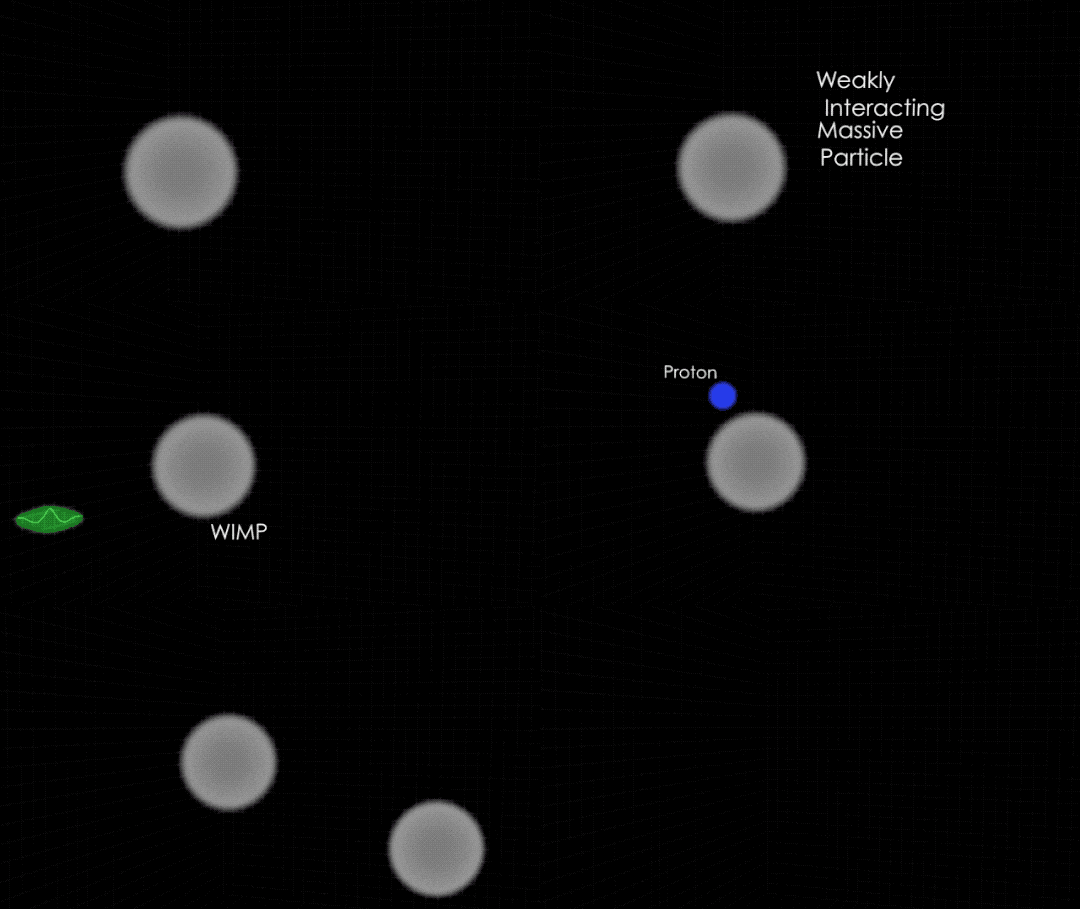
This animation shows a Weakly Interacting Massive Particle, or WIMP, not moving or reacting when an electron or proton pass near to it. Then another WIMP comes into view and they smash together, disappearing as a pair of gamma-rays are emitted.
WIMPs,即弱相互作用大质量粒子,是一类备受青睐的暗物质候选者。有些WIMPs在成对相互作用时可能会相互湮灭,这一过程预计会产生伽马射线——能量最高的光。NASA戈达德太空飞行中心

理论家们设想了一系列WIMP类型以及它们彼此碰撞时会发生什么。有两种可能:WIMPs可能相互湮灭,或者它们可能产生一个短暂的、快速衰变的中间粒子。在这两种情况下,碰撞最终都会在我们的Fermi Gamma-ray Space Telescope探测范围内产生伽马射线——能量最高的光。

近在咫尺的诱人证据

2014年,研究人员查看了来自我们银河系中心附近的费米数据,并减去了已知源产生的伽马射线。结果留下了一个多余的伽马射线信号,它could be consistent with some forms of dark matter。

This animation zooms into an image of the Milky Way, starting with visible light, which looks like puffy clouds of material in shades of light yellow with dark lanes between and stars, as tiny dots, densely packed throughout. At the center is overlaid a gamma-ray map as a purple circle with a bullseye with red at the very center surrounded by yellow, green and blue, representing the strength of the gamma-ray detections, with red being the greatest number of photons detected. When all the known sources are removed, a gamma-ray excess hints at the presence of dark matter.
这段动画放大了一张可见光下的银河系图像,并叠加了NASA费米望远镜拍摄的银河系中心伽马射线图。原始数据过渡到去除所有已知源后的视图,揭示出多余的伽马射线,暗示暗物质的存在。NASA戈达德太空飞行中心、A. Mellinger(中密歇根大学)和T. Linden(芝加哥大学)

虽然这是一个令人兴奋的发现,但这件事还没有定论,因为银河系中心有很多东西都会产生伽马射线。还需要利用其他实验和looking at other astronomical objects进行多次观测,才能确定这种多余信号是否来自暗物质。

Animation of the Fermi Gamma-Ray Telescope in space. The satellite features a large black box structure with white instruments underneath. Two long solar arrays extend from opposite sides, just under the black box.
图中所示为

In the meantime, Fermi will continue the search.

Keep Exploring

Discover More Topics From NASA

内容镜像自 NASA(public domain),中文译文由 AI 辅助生成、仅供参考。